Shakadoo

Everything to do with your shak.

  • Home
  • About Us
  • Advertise
  • Contact Us
  • Press
  • Privacy Policy
You are here: Home / Archives for How-To

Roman Shades: Do They Conquer?

by Marjorie Dorfman Leave a Comment

Roman_shades_2
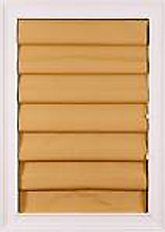
How are Roman shades different from other types?  To say that they block out the sun and shade a room hardly makes them unique, and yet they are. Roman shades stack up in evenly sized panels when the shade is lifted. When the shade is in a lowered state, they create a relatively smooth appearance. Roman shades are versatile and can also be created to reveal a somewhat “hobbled” look, with the vertical panels still showing when the shade is closed.

The raising and lowering of the shades is achieved through a cord system. The cord can be pulled until they reach the desired height, allowing portions of the window to be exposed while blocking out other areas. In this case, the top portion of the roman shades is stacked, while the bottom portion remains extended in the same way it would be if the shade were completely closed.

Roman shades not only come in a wide range of materials and colors, they can also be made with a design, picture or secret message that is revealed once the shade is lowered. Start your own secret DaVinci Code! They can be bought or made in colors to match any room’s décor or any pieces within it, such as tablecloths, pillowcases or upholstery.

Roman shades can be made from many different materials, including wood or fabric. Even within the many choices there are more options, as the type of wood is varied as well. Common possibilities include reed and bamboo, but in reality they are as vast as that old Cole Porter tune, “Anything Goes.”  Wood is a very popular material because it creates a natural look as well as providing a touch of genuine warmth.

Roman shades can also be woven by using different materials together. Rattan, reeds, bamboo, jute and other types of wood weave well together and create a unique look.  Fabrics can be used in a similar fashion.

So have fun in creating your unique set of roman shades. They are sure to conquer, if not invading cities like the people they are named after, at least the rapt attention of anyone entering the room.

Happy Shades!
+1
Tweet
Share
Share
Pin
Shares 0

Installing a Skylight Without Seeing Stars

by Marjorie Dorfman Leave a Comment

Skylight
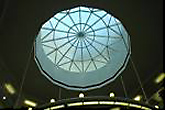
Have you ever installed a skylight in your home? Did you live to tell the tale? Would you do it again yourself or seek professional help (for your brain as well as the skylight)? Here are some thoughts on the matter.

Skylights work wonders for any room, giving the illusion of more open space and reducing the need for electric lighting while providing solar heat. Skylights can also serve as egress to the roof, should a quick escape be somehow necessary.

According to most home improvement experts, you should think twice (and even thrice) before installing your own skylight. One of the major problems is leaking and that rarely happens when a skylight is installed professionally. If you think you might save money by buying a cheaper skylight and going with a professional installer, think twice about that too. Many professional roofers won’t touch a budget skylight because they are almost destined to have problems of leakage.

If you have a skylight that you want removed, forget about doing that yourself and remember that many pros will offer this service when they install the new ones.

Unless you really know what you are doing, don’t try this one alone!

+1
Tweet
Share
Share
Pin
Shares 0

Organizing the Pantry? Is it Possible?

by Marjorie Dorfman Leave a Comment

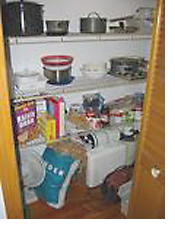
Pantry
While the old mission impossible might have been the name of a now defunct television show, one of the new mission impossibles if you are anything like me, is the organization of the kitchen pantry!

What do I mean by this, those of you organized people out there in blogger land might ask, and well… the question deserves an answer.

Let’s talk about spices first. Are you alphabetical or random? If you are not sure, consider how you organize your address book. If for example, you list your cat’s vet as “Fluffy’s Friend” rather than by the vet’s last name, you are in the functions (or should I say dysfunctional) category. If you are there, don’t despair, for even though that rhymes, I am there too!

I try to alphabetize; I really do. Curry, cardamom etc etc. The problem is that once I use something, I never put it back where it was before. Why, you ask? Well, how else can I keep myself on my own toes?

How about oils and international condiments?  Shouldn’t they be in their own special place in the pantry? Of course, you say and you are right. The rule, as I said before, is that once I use it, I kind of forget where it was before, which means the next time I need it, it will be the same race for the cure as to its exact location.

I can’t speak for you, but it’s clear to me that I am beyond help.

What do YOU think about pantries? Please share unless, that is, you equate them with belfries and the bats that may live therein!

+1
Tweet
Share
Share
Pin
Shares 0

Make Your Own Weed Killer

by badbadivy 4 Comments

Gin_and_tonicChemical weedkiller is expensive, stinky, and potentially hazardous. Fortunately, there is a better weedkiller out there, and it is one you can make yourself using comon household items.

Combine an ounce of white vinegar, an ounce of cheap gin, and 8 ounces of water. Pour the mixture on the weeds, and they will die.

Now, some of my friends and relatives would consider this a complete waste of gin, but I’m a bigger fan of having a weed-free garden than I am a fan of cheap gin!

+1
Tweet
Share
Share
Pin
Shares 0

Floral Arrangements For Your Home: Part Two

by Marjorie Dorfman 1 Comment

The first decision to be made after you purchase your flowers is where in the house they will be placed. Then it can be determined if the finished arrangement should be tall or wide or round and full. Choose a vase that is in proportion to the flowers; it should comprise one-half to one-third of the total arrangement. Use tall, cylindrical vases for arrangements that incorporate line flowers, such as gladiolas, Liatris (gayfeather) Delphinium, snapdragons and bells of Ireland. Use vessels with a belly (such as urns or ginger jars) for mass and filler flowers. This category includes roses, carnations, sunflowers, lilies, tulips, daffodils and chrysanthemums. Filler flowers include statice, baby’s breath, waxflower, Queen Anne’s Lace and Saponaria. There are many materials to choose from, but the decision does require some careful thought.

Condition the flowers by cutting the stems diagonally under water. This prevents air bubbles from forming that can block water from being drawn up into the flowers. The diagonal cut allows a wider surface from which the flowers can drink. Remove the foliage from stems that will be underwater. This discourages the growth of bacteria due to decaying foliage in the water.  Re-cut the stems every few days and change the water. Make sure the container has appropriate water-holding capacity in proportion to the size and quantity of the flowers (large flowers will not work in a bud vase, for example).

Some don’ts for the novice may seem obvious, but should be mentioned anyway. Don’t use tall arrangements for dinner table centerpieces unless you don’t care if your guests can see each other across the table! Don’t combine flowers that do not naturally blend well. For example, the bird of paradise, exquisite all by its lonesome, does not blend well with many other flowers. If you’re not sure, keep it alone. It neither likes nor needs any other company. Do not place flowers in a drafty or warm place, such as an open window or on top of the television. The drafts and heats will cause evaporation and wilting.

For a loose arrangement just clip the ends, place the stems in the vase, pull flowers out and trim a bit here and there until you are pleased with the overall shape. A more planned arrangement is achieved by placing the stems in the vase one at a time until the look pleases you, and then tying the stems together and trimming them evenly. In the case of tropical flowers, Anthuriums, also known as Heart or Flaming Flower, are the longest lasting with a life span of 7-14 days. This exotic flower comes in many colors and the leaves are large and glossy. There are more than 20,000 species of orchids to choose from and they are the very easiest to arrange. They will naturally arch and fill any space beautifully. The Dendrobium Orchid will last from 5-8 days, while Oncidium Orchids will last 7 to 10 days. Longevity in all cases depends not only on the flower care in the home, but also the climactic conditions.

So don’t be afraid to try your hand at tropical flower arranging. Talk to your florist and ask for his suggestions. Start with the simple and work your way up. For all you know, that’s how the rain forest got started.

What are some of YOUR thoughts about flower arranging? Please share them.

+1
Tweet
Share
Share
Pin
Shares 0

Flower Arranging For Your Home: Part One

by Marjorie Dorfman Leave a Comment

Exotic_flowers
The art of flower arranging is centuries old, dating back to the ancient Chinese and Egyptian kingdoms. Flowers are nature’s poetry, a language universal in meaning and beauty. Although an art of the most consummate skill, it is not a deep dark secret passed down from ancient hierophants that cannot be learned. Anyone who loves flowers and is willing to take the time and thought to combine them with discernment can succeed in this art.

While there are no “steadfast rules”, there are some principles of good design to be considered while arranging flowers. Proportion is very important. A floral display is proportionally sound when it seems the right size for its container. It is only dazzling to behold however, if the colors, textures and forms contrast each other. Dark colors look best low in an arrangement, as they appear heavier to the eye. Soft, velvety flower petals are best displayed against shiny, glossy foliage. 

Do not underestimate the importance of of balance as well. This aspect drastically affects the visual aspects of an arrangement and there are two kinds: symmetrical and asymmetrical. Asymmetrical balance requires greater practice, but can be more rewarding and challenging. Harmony is always the final goal of any display. It is the result of blending all of the elements so that they seem to belong together (like the United Nations, only even more colorful).

There is much to learn about the art of flower arranging Stay tuned.
Can YOU add to this?

+1
Tweet
Share
Share
Pin
Shares 0

Cleaning Out the Closets: Through The Abyss

by Marjorie Dorfman Leave a Comment

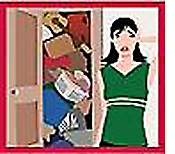
Closetrev_2
The change of seasons at my house has nothing at all to do with budding flowers or falling leaves. It concerns, instead, the cycle of life that revolves around summer and winter clothing. Every year I harbor secret fears about what might be found in the back of my closets. As a writer of horror fiction, the possibilities are endless. Everything is so cluttered that for all I know everything and everyone missing for the last six months might have found a temporary refuge there. The real tragedy is that even if they have, I haven’t even noticed! 

All I have to do is open the closet door and I am “whelmed” as Mel Brooks used to say, at the task that lies before me. Piles and piles block my view; my heaps have heaps. Suddenly everything I own and cannot find is looking back at me with accusing, disorganized eyes. I usually tackle the floor and my shoes first. That gives me a place, however tenuous, to stand. Then I work my way up to what’s dangling, sort of hanging and should be hanging.

Do not attack first and ask questions later. (This isn’t your mother-in-law; it’s your closet). Go through everything with three alternatives in mind; give away, put away or throw away. Reorganization should include identifying what you use and what you love. Decide what is important, garment by garment, shoe by shoe, box by box, missing person by missing person.

Give everything else away. Consider yourself an anorexic and your clothes extra pounds or worse, fattening food. You must summon the inner strength to make these purging and sorting decisions. Remember that it only hurts for a little while, especially if you force yourself to clean up and put away as part of your daily routine. I can’t do it, but maybe you can.

Another way to ensure that everything gets done is to take everything out of the closet and throw it on your bed. Then step back and analyze the situation. Reduce your closet to two activity zones; need and don’t need (but would if I could find it). By throwing everything in one place you must utilize every day you will be forced to complete the job at hand before bedtime. (If you get really disgusted, there’s always the floor or a nearby motel.) 

     There’s no point in denying the psychological aspects of closet clutter. Avoid asking questions such as: Why do I like chaos? What does all this disorganization do for me? Does chaos offer me something my husband can’t? And last but not least, Dr. Phil’s famous question: How’s that working for you?” Think instead of what you could become if you were just a little bit more organized. Perhaps a king among kings or a queen among queens (if you could find your crown). Who knows what awaits us all in the organized after-life?

All anyone can really do, I suppose, is hope for the best. Maybe the Holy Grail isn’t really in the back of my hall closet. I can’t open it anyway. Or what about all those missing planes and ships in the Bermuda Triangle? Nah, my closets aren’t big enough. Still, who knows what clutter lurks beyond the confines of one’s hall closet? The clutter bogeyman, that’s who!

What does YOUR closet look like?

+1
Tweet
Share
Share
Pin
Shares 0

Cleaning Out the Refrigerator: Nightmare in The Kitchen

by Marjorie Dorfman Leave a Comment

Watching a horror movie about a giant vegetable devouring everyone in your hometown except your in-laws is one way to spend a quiet evening. It’s quite another to become acquainted with the weird intruders that have invaded your home and are nested very comfortably and rent-free in your refrigerator. They live a lush life among those of us of a culinary bent who cook a lot and have many leftovers.

One of the problems with leftovers is that after a day or two I forget they are there. They are only brought to my attention if I am searching for something in the fridge and I happen to fall upon something that looks a little strange or hear a little muffled cry from the wilds of the back shelf. If I feel brave, I unwrap the foil. I am always amazed that the smell alone has failed to notify me of its presence.

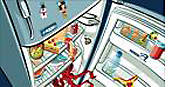
About a month ago I was looking for a carrot in the vegetable drawer and I found this shriveled greenish thing with flaccid appendages lying under the bag of carrots. It turned out to be a very old head of lettuce, but for a while there I was thinking about that movie, Fridgerev
 and where he or she was living these days.

How do you know when it’s time to clean out the refrigerator? It will let you know is the answer. Trust me on this, for I know little else. One clear indicator is when the door will not open or close easily. If you ignore that sign from the refrigerator deity, things will only get worse. Soon friends and neighbors will notice vegetation where there used to be enamel and porcelain. The huddled green masses now yearning to breathe free are not anywhere near The Statue of Liberty. They are reproducing in your kitchen!
Use your five senses. (They’re not doing anything anyway.). The power of smell cannot be excluded from this impromptu, albeit insignificant study. We all know that the subject never was roses, but smell along with sight will never fail to direct you to the problem areas in your refrigerator.. Talk to the smell and assure it that it will be in its proper home very soon. Then be strong and throw the item out. Whatever it was, it’s garbage now.

The power of touch can be under-rated. Feeling suspicious items can be a bit more adventurous and is not recommended for the faint-hearted. There is no guarantee that whatever is inside won’t feel you back and you might not like that. Proceed at your own risk. If you must touch, stroke gently, but throw out anything immediately if you feel any sort of pulse. Better yet, flush it down the toilet where it can’t come back and hurt you..

Try to find a way to identify the older items in your refrigerator. One cannot ask their age as that is improper, but one can employ other techniques that can help us do so. Different colored foil; use it even if it hasn’t been invented yet. Use green for items wrapped in April, red for December, orange for October etc. etc. This way, you can spot at a glance the old from the new (but not the borrowed from the blue).

Good luck and remember your refrigerator is your friend.

+1
Tweet
Share
Share
Pin
Shares 0

Bunny Napkins

by Sarah C. 1 Comment

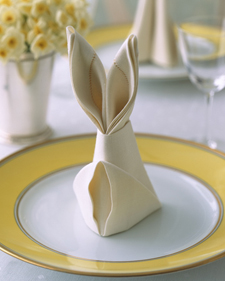
Bunny_1
If your looking for a new napkin-folding technique in time for Easter, check out the Martha Stewart how-to for this cute bunny. It would literally take me until April 8th to figure this out. Hopefully you have better hand-eye coordination than I have.

If you just like the lovely yellow plates, try Wonderful World Yellow from Villeroy and Boch.

Instructions from MarthaStewart.com:

Easter rabbit-shaped napkins are a festive detail for the holiday
table, and they only require a few simple folds. Well-starched crisp
cotton or linen will transform into the sturdiest bunnies. Fold napkins
the day before your meal so your "warren" is full when guests arrive.

1. Fold starched napkin into thirds.

2. Crease in half to create a center line for reference; fold top corners down along this line.

3. Fold up from bottom corners along dotted lines.

4. Bring left and right edges together on center line.

5. Flip upside down and over. Turn up bottom point.

6.
To fasten: Fold left and right corners back; tuck one corner into the
pocket of the other. Pull out bunny ears first; open up base.

Via Cribcandy.

+1
Tweet
Share
Share
Pin
Shares 0

Pressure Washing Your Deck

by badbadivy Leave a Comment

It’s spring, which means it’s spring cleaning time for both the inside and the outside of your home. Now is a great time to get out there and pressure wash your deck. You can generally rent a pressure washer from most home improvement centers quite inexpensively.

Pressure_washer
When you wash your deck, here are some tips to keep in mind:

  1. The minimum pressure you will need to effectively clean your deck is 1500 pounds per square inch (psi).

  2. There are several different nozzle tips you can use with the pressure washer. Use a wide-angle tip of 25-40 degrees for best results. Do not use a 0 deg. tip on wood. It will cause pitting.
  3. Clean the deck with a solution meant to be used with your type of power washer. Use a swinging motion like you are swinging a golf club. Let the solution sit for several minutes.
  4. Never let the cleaning solution sit on your deck for longer than 15
    minutes. It will start to dry and will leave residue on your deck.
    Rinse with plenty of fresh water to get all the chemical off.
  5. Wear goggles or glasses to protect your eyes from the chemicals.
  6. Keep the jet in motion at all times to keep from pitting the wood.
  7. Make sure not to get the jet too close to the wood. This can cause pitting or scarring of the wood.
  8. Make sure to follow the manufacturer’s specifications when using the pressure washer.

Allow 48 hours for your deck to thoroughly dry. Then you can stain or seal your deck. It will look totally revitalized!

+1
Tweet
Share
Share
Pin
Shares 0
« Previous Page

Subscribe to the Shak

Copyright © 2023 · Shak Media · All Rights Reserved