SO…I don’t watch many Wes Anderson films, and I don’t use an American Express card. But it’s still a fun commercial to see.
Happy Friday!
Everything to do with your shak.
SO…I don’t watch many Wes Anderson films, and I don’t use an American Express card. But it’s still a fun commercial to see.
Happy Friday!
Even though I don’t use American Express, this commercial featuring Wes Anderson made me laugh.
Happy Friday!

Last night, President Barack Obama delivered the first State of the Union Address of his presidency. The centerpiece of the speech was the emphasis on job creation. Acknowledging that the economy still needs help, the President laid out plans designed to help encourage more jobs. In addition to highlighting some of the projects in the pipeline, he also pointed out that he plans to offer tax breaks to companies that hire more workers. Employment is a big deal, since it affects many other aspects of the economy.
Employment wasn’t the only focus of the State of the Union last night; President Obama also accepted responsibility for some of the mistakes he made his first year. He also reminded us that fixing two wars and a financial catastrophe is not something that can be done in only one year.
Other plans Obama offered included thoughts on developing alternative energy technology, education reform, health care reform and financial reform. It’s an ambitious list, but the President is in it for the long haul — however long the American people let him stay in for.
![Reblog this post [with Zemanta]](http://img.zemanta.com/reblog_e.png?x-id=ca248605-6de5-4dcf-bf46-4a1ae9aff68a)

Last night President Barack Obama offered his first State of the Union Address. One of the main issues addressed in the speech was employment. The jobs situation remains precarious, and the President wants to show that he is listening to the concerns of the people. As a result, it is little surprise that he offered some plans to encourage increased job creation, including a plan for tax breaks for companies willing to hire more workers.
In addition to addressing employment, the President also stressed the need to develop alternative energy technologies. He also talked of education reform, health care reform and financial regulatory reform. He also made sure to take responsibility for his mistakes, as well as point out that some things couldn’t be avoided, and that there is still a ways to go.
In the end, it will be interesting see whether any of his ideas can be put into play. While the President does have some influence over the direction of some policies, the bottom line is that actual legislation is in the hands of others.
![Reblog this post [with Zemanta]](http://img.zemanta.com/reblog_e.png?x-id=0e557107-7837-4342-bc73-67c54a837938)
I recently received this question from a reader:
What form do you use to file your mileage usage?
This is a good question. When you are filing for business expenses (such as driving your car for your home business) you actually keep track of your mileage and report it on your tax form as a business expense (for a sole proprietorship, it goes on Schedule C). There is a worksheet in your instruction booklet that helps you figure your mileage.
If you have mileage related to working for someone else for your job, you keep track of it and you put it on Form 2106, which includes all employee business expenses that you might pay throughout the year. However, it is important to note that these must be expenses that have not been reimbursed to you by your employer.
For charity mileage, medical mileage, job hunting, educational and moving expenses, there are places you can deduct these on your form 1040, and some of them are deducted on Schedule A when you itemize. Before you deduct any mileage, though, you want to make sure that you have accurate records, in case you are flagged for an audit. You want to make sure that all mileage was only for the use you state. No personal mileage deductions. A tax professional can help you sort through everything if you have more questions, since I am not a tax professional.
![Reblog this post [with Zemanta]](http://img.zemanta.com/reblog_e.png?x-id=13e9c752-cc10-46b1-a64a-c585fb2264cc)

The housing market continues to struggle as home prices fall and mortgage applications drop. The Market Composite Index, which measures the volume of mortgage applications each week, dropped this past week. One of the biggest reasons is the fact that the refinancing portion of the index dropped.
Apparently, even though mortgage rates are low, people are reluctant to refinance their homes. This is causing mortgage applications to drop. Perhaps some are waiting to see if mortgage interest rates will drop back below 5%, since mortgage rates rose last week. Another issue is that home values have not been rising, and do get the 80% loan to value ration that many mortgage lenders are asking for is difficult.
Those with mortgages serviced by Fannie Mae or Freddie Mac, though, can take advantage of a refinance program from the government that allows a 125% LTV.
![Reblog this post [with Zemanta]](http://img.zemanta.com/reblog_e.png?x-id=38ee02eb-ed7d-4954-92b4-da604d3595dd)

It’s a new year, and if you are like most people, you thinking of how to improve your budget for 2010. For someone with a home business, budgeting is especially important. This is because you may not have a steady income each month. Some months you may make more than other months. As a result, budgeting becomes especially important. Here is a simple process that can help you budget for the new year:
1. Look at your total earnings for last year. Divide that by 12 to get a monthly average.
2. Look at your total expenses for last year. Divide that by 12 to get a feel for your monthly obligations.
3. Create a monthly budget based on your income and expenses.
4. On months when you actually make more than your average income, put the money in a high yield savings accounts.
5. On months when you fall short of the average income, you can use what you have saved up to make up the difference.
This process is easily done when you have personal finance software, or bookkeeping software. You can create a report that breaks it all down for you, including allowing you to see categories (entertainment, eating out, etc.) where you can cut back if necessary. If you don’t have personal finance software, you should consider getting some in order to more easily track your cash flow.
![Reblog this post [with Zemanta]](http://img.zemanta.com/reblog_e.png?x-id=ccca1f68-3f7e-4ee0-b007-511e552e1d92)
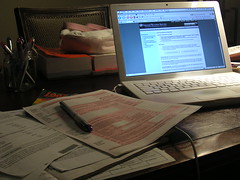
When it comes to preparing your taxes, you want to be careful. It’s not just about avoiding a tax audit. In fact, you might need to overcome some assumptions when you are ready to file. And, whether you file yourself, or have a tax professional take care of it, there are a few things to keep in mind. Roni Deutch, “The Tax Lady” offers some insight into items that you might overlook when preparing your taxes. As you get your 2009 tax return together, and as you plan for taxes in 2010, consider The Tax Lady, and keep these 5 things in mind:
1. Changes to your family: Childbirth, college, having your parents move in, marriage and divorce can all affect the tax breaks you are eligible for.
2. Home changes: When you move, there are deductions associated with your situation. And don’t forget the homebuyer tax credit.
3. Job changes: All things related to the job search can affect your tax return, especially with rules for unemployment benefits.
4. Major purchases: If you made a large purchase, let your tax preparer know. It may be nothing, but it may also impact your situation.
5. Bankruptcy: Your taxes are filed differently, depending on the kind of the bankruptcy you have. Be sure to have someone knowledgeable help you this.
![Reblog this post [with Zemanta]](http://img.zemanta.com/reblog_e.png?x-id=877ce0ed-220f-486a-824e-bbb77c5eb2ae)

There are a number of work from home scams floating around out there, from the “Google Jobs” scam to different networking marketing scams. While there are some legitimate marketing scams, including MLM, it is important to note that you still need to be careful. You want to be careful to avoid scams that could turn your home business dream into a nightmakre.
Online Home Business Idea recommends that you take the following steps to avoid work from home network marketing scams:
* Research the company to make sure that it is established, and has a track record of several years. Check with the BBB for complaints.
* Look at the products being promoted. Are they useful? Would you want to buy the products? Be wary of products that offer some sort of “miracle”, “cure”, or “amazing money making potential”.
* Check with others who have done this, probing them for how they make their money, and proof that they are earning well.
You can never be 100% sure that something will work out. But you do need to be careful. Do your homework, and if something doesn’t feel right, or if it seems too good to be true, stay away.
![Reblog this post [with Zemanta]](http://img.zemanta.com/reblog_e.png?x-id=33660241-a391-4ca0-9620-b1db241caf6c)

Ever since the financial crisis, Fannie Mae and Freddie Mac have been wards of the federal government, under direct control. This happened when the companies appeared to be on the verge of collapse, and ready to take down a large portion of the mortgage market. With the two GSEs accounting for about 70% of loan originations due to FHA loans, a collapse would have been devastating. Fannie and Freddie are the biggest mortgage lenders in the country, between originations and servicing.
But Barney Frank doesn’t want Fannie Me and Freddie Mac to go back to the way they were before. National Mortgage News Online reports on his opposition:
Chairman Frank said he plans to hold hearings on restructuring the U.S. housing finance system and he has no desire to see Fannie and Freddie return to the former “hybrid” status as a private companies with a public mission.
It is unclear about what might happen going forward, but if Fannie and Freddie are no longer GSEs, they would end up either being completely private, or they would be turned into government home financing programs.
![Reblog this post [with Zemanta]](http://img.zemanta.com/reblog_e.png?x-id=5991e116-a635-4364-8044-3ab576524721)