Shakadoo

Everything to do with your shak.

  • Home
  • About Us
  • Advertise
  • Contact Us
  • Press
  • Privacy Policy
You are here: Home / Archives for Marjorie Dorfman

Intruder In The House: Internet Safety For Children

by Marjorie Dorfman Leave a Comment

Computer
Have you locked your doors, barred your windows and checked the darkest corners of your closet? Sad to say, even if you do, these precautions may not be enough. The intruder of whom I speak cannot be repelled by the finest locks or the most conscientious police force. Entry into our homes is with our permission and sometimes blessing. Our brazen interloper lurks behind the door to our family rooms and stalks our children when we cannot protect them. He comes unbidden through the mouse of our computers as the most dangerous kind of enemy known to man; one veiled as a friend.

Internet safety vs. freedom is a long standing issue, but behind it all is something much deeper and far more sinister. The vast resources offered by the Internet are like crack-cocaine to the child predators who endlessly stalk the chat rooms that attract the victims they seek. They are patient as they hide in wait, like snakes in the grass, for the right moment to strike. According to a recent poll, seventy-five per cent of all child molesters watch the pornographic material available on the Internet web sites today. Our children really are talking to strangers, dangerous strangers more terrifying than anything our wildest nightmares could conjure.

Like the alien creature of celluloid fame, our intruder metamorphoses to disguise its evil intent and adjust to the avenues available. He/she invades our home via unsolicited e-mail. A child home alone from school can be whirled into the filty vortex of child pornography through the simple click of a button. As parents, we must take action and become our own crusading Darth Vader-Naders!

The pull of the chat rooms is understandable and it must be said in all fairness, that there are many wonderful things about them. Predators seek territory; it is not the Internet’s fault that crime has penetrated its borders any more than any victimof robbery or personal assault is responsible for the actions of their predators. For pre-teens and teenagers, assuming different identities offers an appeal that is difficult to match. The only limits then become those defined by imagination. The inportant question is: How can we keep the good aspects of the Internet and eradicate the bad?
There are blockers we can put on our home computers. Cyber-crime is spreading rapidly and we parents must act as a vigilante posse until the sheriff and reinforcements arrive. There is no other choice but to make this vast frontier called the Internet safe for the future, for our children, grandchildren and for Darth Vader- Nader too!
Are YOUR children safe from Internet predators?

+1
Tweet
Share
Share
Pin
Shares 0

Floral Arrangements For Your Home: Part Two

by Marjorie Dorfman 1 Comment

The first decision to be made after you purchase your flowers is where in the house they will be placed. Then it can be determined if the finished arrangement should be tall or wide or round and full. Choose a vase that is in proportion to the flowers; it should comprise one-half to one-third of the total arrangement. Use tall, cylindrical vases for arrangements that incorporate line flowers, such as gladiolas, Liatris (gayfeather) Delphinium, snapdragons and bells of Ireland. Use vessels with a belly (such as urns or ginger jars) for mass and filler flowers. This category includes roses, carnations, sunflowers, lilies, tulips, daffodils and chrysanthemums. Filler flowers include statice, baby’s breath, waxflower, Queen Anne’s Lace and Saponaria. There are many materials to choose from, but the decision does require some careful thought.

Condition the flowers by cutting the stems diagonally under water. This prevents air bubbles from forming that can block water from being drawn up into the flowers. The diagonal cut allows a wider surface from which the flowers can drink. Remove the foliage from stems that will be underwater. This discourages the growth of bacteria due to decaying foliage in the water.  Re-cut the stems every few days and change the water. Make sure the container has appropriate water-holding capacity in proportion to the size and quantity of the flowers (large flowers will not work in a bud vase, for example).

Some don’ts for the novice may seem obvious, but should be mentioned anyway. Don’t use tall arrangements for dinner table centerpieces unless you don’t care if your guests can see each other across the table! Don’t combine flowers that do not naturally blend well. For example, the bird of paradise, exquisite all by its lonesome, does not blend well with many other flowers. If you’re not sure, keep it alone. It neither likes nor needs any other company. Do not place flowers in a drafty or warm place, such as an open window or on top of the television. The drafts and heats will cause evaporation and wilting.

For a loose arrangement just clip the ends, place the stems in the vase, pull flowers out and trim a bit here and there until you are pleased with the overall shape. A more planned arrangement is achieved by placing the stems in the vase one at a time until the look pleases you, and then tying the stems together and trimming them evenly. In the case of tropical flowers, Anthuriums, also known as Heart or Flaming Flower, are the longest lasting with a life span of 7-14 days. This exotic flower comes in many colors and the leaves are large and glossy. There are more than 20,000 species of orchids to choose from and they are the very easiest to arrange. They will naturally arch and fill any space beautifully. The Dendrobium Orchid will last from 5-8 days, while Oncidium Orchids will last 7 to 10 days. Longevity in all cases depends not only on the flower care in the home, but also the climactic conditions.

So don’t be afraid to try your hand at tropical flower arranging. Talk to your florist and ask for his suggestions. Start with the simple and work your way up. For all you know, that’s how the rain forest got started.

What are some of YOUR thoughts about flower arranging? Please share them.

+1
Tweet
Share
Share
Pin
Shares 0

Flower Arranging For Your Home: Part One

by Marjorie Dorfman Leave a Comment

Exotic_flowers
The art of flower arranging is centuries old, dating back to the ancient Chinese and Egyptian kingdoms. Flowers are nature’s poetry, a language universal in meaning and beauty. Although an art of the most consummate skill, it is not a deep dark secret passed down from ancient hierophants that cannot be learned. Anyone who loves flowers and is willing to take the time and thought to combine them with discernment can succeed in this art.

While there are no “steadfast rules”, there are some principles of good design to be considered while arranging flowers. Proportion is very important. A floral display is proportionally sound when it seems the right size for its container. It is only dazzling to behold however, if the colors, textures and forms contrast each other. Dark colors look best low in an arrangement, as they appear heavier to the eye. Soft, velvety flower petals are best displayed against shiny, glossy foliage. 

Do not underestimate the importance of of balance as well. This aspect drastically affects the visual aspects of an arrangement and there are two kinds: symmetrical and asymmetrical. Asymmetrical balance requires greater practice, but can be more rewarding and challenging. Harmony is always the final goal of any display. It is the result of blending all of the elements so that they seem to belong together (like the United Nations, only even more colorful).

There is much to learn about the art of flower arranging Stay tuned.
Can YOU add to this?

+1
Tweet
Share
Share
Pin
Shares 0

Cleaning Out the Closets: Through The Abyss

by Marjorie Dorfman Leave a Comment

Closetrev_2
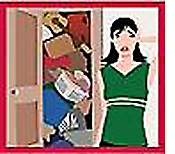
The change of seasons at my house has nothing at all to do with budding flowers or falling leaves. It concerns, instead, the cycle of life that revolves around summer and winter clothing. Every year I harbor secret fears about what might be found in the back of my closets. As a writer of horror fiction, the possibilities are endless. Everything is so cluttered that for all I know everything and everyone missing for the last six months might have found a temporary refuge there. The real tragedy is that even if they have, I haven’t even noticed! 

All I have to do is open the closet door and I am “whelmed” as Mel Brooks used to say, at the task that lies before me. Piles and piles block my view; my heaps have heaps. Suddenly everything I own and cannot find is looking back at me with accusing, disorganized eyes. I usually tackle the floor and my shoes first. That gives me a place, however tenuous, to stand. Then I work my way up to what’s dangling, sort of hanging and should be hanging.

Do not attack first and ask questions later. (This isn’t your mother-in-law; it’s your closet). Go through everything with three alternatives in mind; give away, put away or throw away. Reorganization should include identifying what you use and what you love. Decide what is important, garment by garment, shoe by shoe, box by box, missing person by missing person.

Give everything else away. Consider yourself an anorexic and your clothes extra pounds or worse, fattening food. You must summon the inner strength to make these purging and sorting decisions. Remember that it only hurts for a little while, especially if you force yourself to clean up and put away as part of your daily routine. I can’t do it, but maybe you can.

Another way to ensure that everything gets done is to take everything out of the closet and throw it on your bed. Then step back and analyze the situation. Reduce your closet to two activity zones; need and don’t need (but would if I could find it). By throwing everything in one place you must utilize every day you will be forced to complete the job at hand before bedtime. (If you get really disgusted, there’s always the floor or a nearby motel.) 

     There’s no point in denying the psychological aspects of closet clutter. Avoid asking questions such as: Why do I like chaos? What does all this disorganization do for me? Does chaos offer me something my husband can’t? And last but not least, Dr. Phil’s famous question: How’s that working for you?” Think instead of what you could become if you were just a little bit more organized. Perhaps a king among kings or a queen among queens (if you could find your crown). Who knows what awaits us all in the organized after-life?

All anyone can really do, I suppose, is hope for the best. Maybe the Holy Grail isn’t really in the back of my hall closet. I can’t open it anyway. Or what about all those missing planes and ships in the Bermuda Triangle? Nah, my closets aren’t big enough. Still, who knows what clutter lurks beyond the confines of one’s hall closet? The clutter bogeyman, that’s who!

What does YOUR closet look like?

+1
Tweet
Share
Share
Pin
Shares 0

Cleaning Out the Refrigerator: Nightmare in The Kitchen

by Marjorie Dorfman Leave a Comment

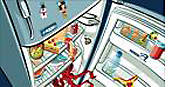
Watching a horror movie about a giant vegetable devouring everyone in your hometown except your in-laws is one way to spend a quiet evening. It’s quite another to become acquainted with the weird intruders that have invaded your home and are nested very comfortably and rent-free in your refrigerator. They live a lush life among those of us of a culinary bent who cook a lot and have many leftovers.

One of the problems with leftovers is that after a day or two I forget they are there. They are only brought to my attention if I am searching for something in the fridge and I happen to fall upon something that looks a little strange or hear a little muffled cry from the wilds of the back shelf. If I feel brave, I unwrap the foil. I am always amazed that the smell alone has failed to notify me of its presence.

About a month ago I was looking for a carrot in the vegetable drawer and I found this shriveled greenish thing with flaccid appendages lying under the bag of carrots. It turned out to be a very old head of lettuce, but for a while there I was thinking about that movie, Fridgerev
 and where he or she was living these days.

How do you know when it’s time to clean out the refrigerator? It will let you know is the answer. Trust me on this, for I know little else. One clear indicator is when the door will not open or close easily. If you ignore that sign from the refrigerator deity, things will only get worse. Soon friends and neighbors will notice vegetation where there used to be enamel and porcelain. The huddled green masses now yearning to breathe free are not anywhere near The Statue of Liberty. They are reproducing in your kitchen!
Use your five senses. (They’re not doing anything anyway.). The power of smell cannot be excluded from this impromptu, albeit insignificant study. We all know that the subject never was roses, but smell along with sight will never fail to direct you to the problem areas in your refrigerator.. Talk to the smell and assure it that it will be in its proper home very soon. Then be strong and throw the item out. Whatever it was, it’s garbage now.

The power of touch can be under-rated. Feeling suspicious items can be a bit more adventurous and is not recommended for the faint-hearted. There is no guarantee that whatever is inside won’t feel you back and you might not like that. Proceed at your own risk. If you must touch, stroke gently, but throw out anything immediately if you feel any sort of pulse. Better yet, flush it down the toilet where it can’t come back and hurt you..

Try to find a way to identify the older items in your refrigerator. One cannot ask their age as that is improper, but one can employ other techniques that can help us do so. Different colored foil; use it even if it hasn’t been invented yet. Use green for items wrapped in April, red for December, orange for October etc. etc. This way, you can spot at a glance the old from the new (but not the borrowed from the blue).

Good luck and remember your refrigerator is your friend.

+1
Tweet
Share
Share
Pin
Shares 0

The Blender In Your Home: However Did That Happen?

by Marjorie Dorfman Leave a Comment

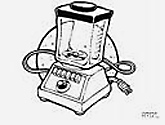
What connection does the modern blender have with a famous American bandleader?

Blender
In 1910, Fred Osius, L.H.Hamilton and Chester Beach formed the Hamilton Beach Manufacturing Company. Osius held the patent for the blender although his was not the first one created. He did not have the money to thrust his new invention into the marketplace. He knew that gadgets always fascinated Fred Waring, who had achieved fame with his big band, Fred Waring and The Pennsylvanians and that Waring had the money to indulge in his hobbies.

One night, after a radio broadcast at New York’s Vanderbilt Theater, Osius talked his way into Waring’s dressing room and pitched his idea. Waring agreed to fund his research but six months and $25,000 later, there were still blender problems. Waring then dumped Osius and redesigned the blender himself. The result was the “Miracle Mixer Blender,” which sold for $29.75, and was introduced to the public at the National Restaurant Show in Chicago. In 1938, Waring renamed his Miracle Mixer Corporation to the Waring Corporation, and the mixer’s name was officially changed to the Waring Blender.

Waring once said that this mixer “will revolutionize American drinks” and he was right. He could not have imagined, however that the blender would be used inn hospitals for the implementation of special diets and research. Dr. Jonas Salk used it while developing the vaccine for polio.

So the next time you blend or pulse, stop for a moment and think about how much easier your life is because of this machine that asks nothing of you and sits quietly on your kitchen counter. Maybe you should consider even saluting it once, just to show it a bit of the respect it deserves.

+1
Tweet
Share
Share
Pin
Shares 0

Bathroom Ideology

by Marjorie Dorfman Leave a Comment

Many of us, particularly city-dwellers, suffer from what non-authorities call the “small master bathroom syndrome.”  The one major symptom of this malady is the prevalence of traffic jams both on the highway known as the hallway leading to the bathroom of your home and in the bathroom itself. What can you do about cabinets so packed nothing can be added or extracted and toiletries that seem to reproduce overnight on your crowded shelves? Well, read on, whether you believe in organization or not.

According to a survey conducted by Moen (you know, those interesting faucet people) more than half the master bathrooms are less than 75 square feet, forcing most homeowners to make do with very limited space. Yet Tim Bitterman, products manager of the Inspirations by Moen line of bath accessories, insists there are effective ways to reduce congestion in this crowded room. He says, “Careful design, dedicated space for each individual and a willingness to compromise can make even the smallest room feel more spacious.”

Never Underestimate the Power of Organization

While all living things need love, small spaces scream for organization.  A small space can only be made to look smaller if it is crammed with too many toiletries, cleaning products and small appliances like hair dryers and such.  According once again to Mr. Bitterman, “it’s all about creating more room and carving out your own space.”  Clear the sink, clean out the medicine cabinet and those things that you have been storing under the sink (it’s time for Uncle Ambrose to come out, come out wherever he is and go home where he belongs.) In short, take stock of what you own and what you use on a daily basis. Keep only that which you really need.

Stay tuned for some more bathroom thoughts and tips for creating more space.

Do YOU have any to add to the list?  Please share.

+1
Tweet
Share
Share
Pin
Shares 0
« Previous Page

Subscribe to the Shak

Copyright © 2023 · Shak Media · All Rights Reserved